Research & experimentation
My lab work includes calcium imaging with microfabrication, plus particle characterization and biosensor validation. Structured experiments tie the work together.
I’m interested in biomedical innovation that turns an early idea into a practical system. My work starts with building something useful and continues through careful testing.

Biomedical Engineering at UNC-Chapel Hill
My lab work includes calcium imaging with microfabrication, plus particle characterization and biosensor validation. Structured experiments tie the work together.
I use CAD and computer vision to prototype quickly. Movement tracking helps me answer focused technical questions.
I use technical literature and competitive analysis to understand a market. Workflow design and product positioning shape the response.

Exploring how hand recovery after surgery can be measured more consistently outside the clinic. I moved from an early wearable-glove concept toward a webcam-guided movement assessment experience for structured checks of wrist mobility and fine hand movement. The goal is to make repeatable at-home assessment possible without adding specialized hardware or a complicated setup.

Exploring how new clinical-trial activity can be translated into usable sales intelligence for life-science companies. The workflow identifies product needs and enriches relevant contacts. The result is a more actionable lead pipeline. I focused on making each output connect to a concrete commercial question rather than simply presenting a larger volume of data.
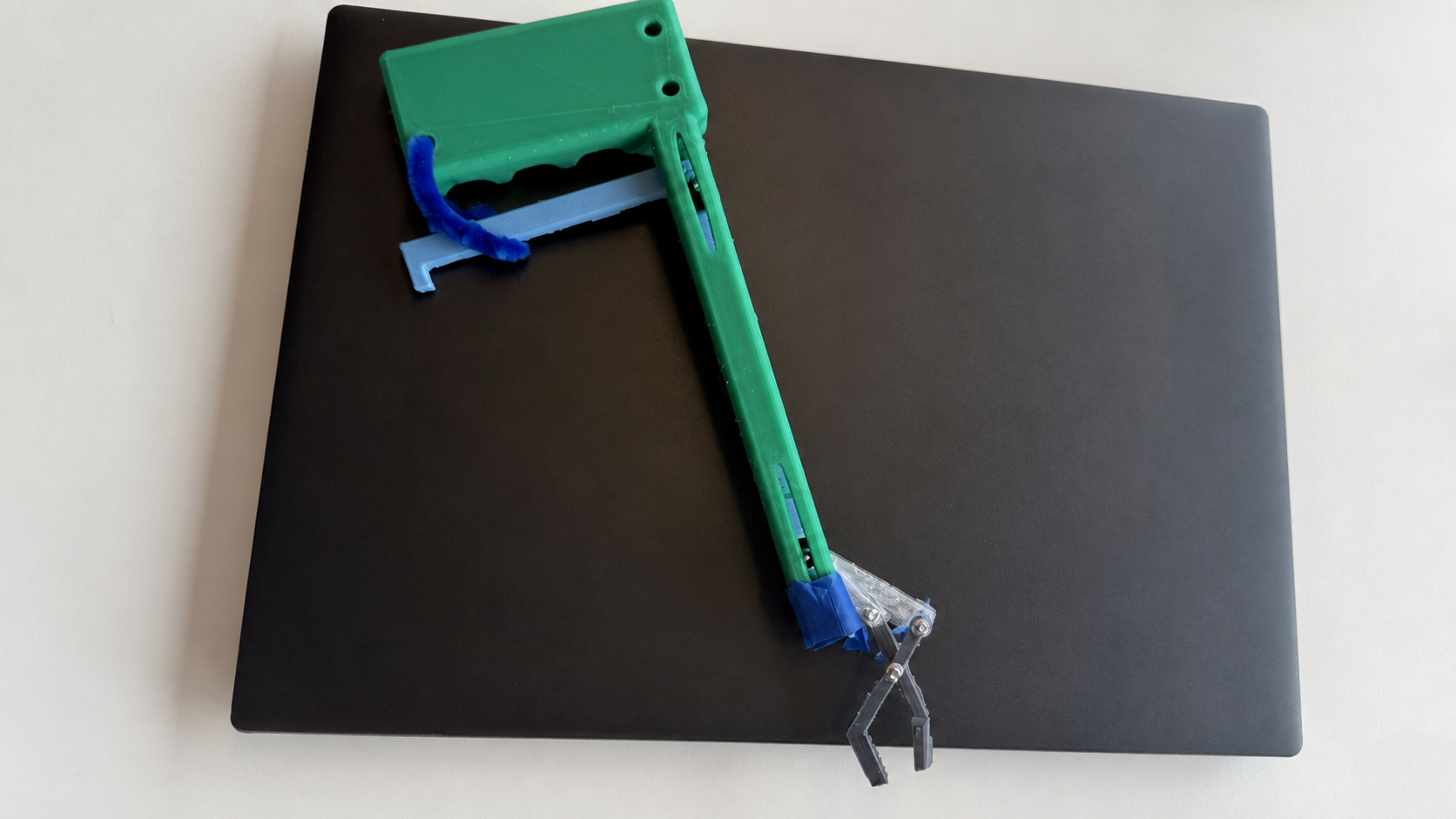
At the UNC Interprofessional Design-a-thon, I worked with clinical stakeholders to address an everyday challenge faced by patients living with an LVAD system. I translated that need into requirements for an assistive grabbing device and led rapid prototyping using CAD and 3D printing. Feedback from the clinical team guided changes to the fit and function of the prototype.
Researching silicon nanowire systems for optical neural stimulation without requiring genetic modification.
I prepare and transfer nanowires, then use calcium imaging to test stimulation parameters. I analyze neuronal activation to understand the response. The broader technical question is how a material interface can produce precise stimulation while avoiding more invasive biological modification.
Evaluated emerging biomedical technologies from both a technical and adoption standpoint.
I studied the competitive landscape and market size. I also looked at customer segments and workflow barriers, then mapped the validation work needed for product positioning. The findings clarified product direction and validation priorities. Adoption strategy followed from those decisions.
Worked across nanoparticle drug delivery and biosensor development.
I functionalized milk-derived extracellular vesicles using click chemistry. Particle characterization covered DLS and NTA, with zeta potential as another measurement. I also supported a hydrogel/DNAzyme cadmium biosensor. The experience strengthened my ability to move between wet-lab protocols and quantitative characterization while keeping device-level questions in view.

Multi-component airway device model developed as an assembled CAD system with several interacting parts.

Full inhaler and spacer assembly modeled in Onshape to study component fit within a complete assembly.

Fusion 360 mold design developed for research use, with repeated channel features for PDMS fabrication.
Start with the user and the system. Then define the constraint that matters and decide how to measure it.
Create the simplest useful prototype that can answer the current technical question.
Collect data and look for failure points. Use the result to check the assumptions.
Change the design based on what the experiment or user feedback actually shows.
The best way to reach me about engineering, research, or project opportunities is by email or LinkedIn.